Last week: position it before you build anything.
This week is about what happens once someone's actually walked through the door, because getting them in is wasted if the programme itself doesn't hold up.
The mistake here is a common one, and I made it myself early on.
You take your normal programme, the one built for twenty-five-year-olds with a decade of training under them, and you subtract.
Remove the barbell work.
Drop the loading.
Slow the tempo.
Call what's left a 50+ programme.
It isn't one. It's half of one, with the interesting bit taken out.
Why subtraction doesn't work
Most people coming to you for a 50+ programme have a low training age, whatever their birth certificate says.
Someone who hasn't lifted anything heavier than a shopping bag in twenty years is, from a training perspective, a beginner. Layer that on top of the real physiological effects of ageing on bone density and joint structure, and you've got a population that needs a programme built from the ground up for them, not a diluted version of someone else's.
Less is genuinely more here.
Not the slogan version of more, the actual physiological version. Fewer variables, more attention to each one, more time spent building the tissue tolerance and movement competence that this audience often skipped entirely the first time round because nobody taught them properly at twenty.
But don't swing the other way either
Here's where it gets interesting, because the failure mode on the other side is just as common and does just as much damage.
Coaches hear "less is more," take it as permission to make everything easy, and end up coddling a group of people who didn't ask to be coddled.
Nobody in a 50+ programme wants to be handled with kid gloves.
They want to get stronger. They want to be challenged in a way that's calibrated to them.
Most of all, they want to feel proud of what they can actually do right now, not what they used to be able to do or what they're being protected from attempting.
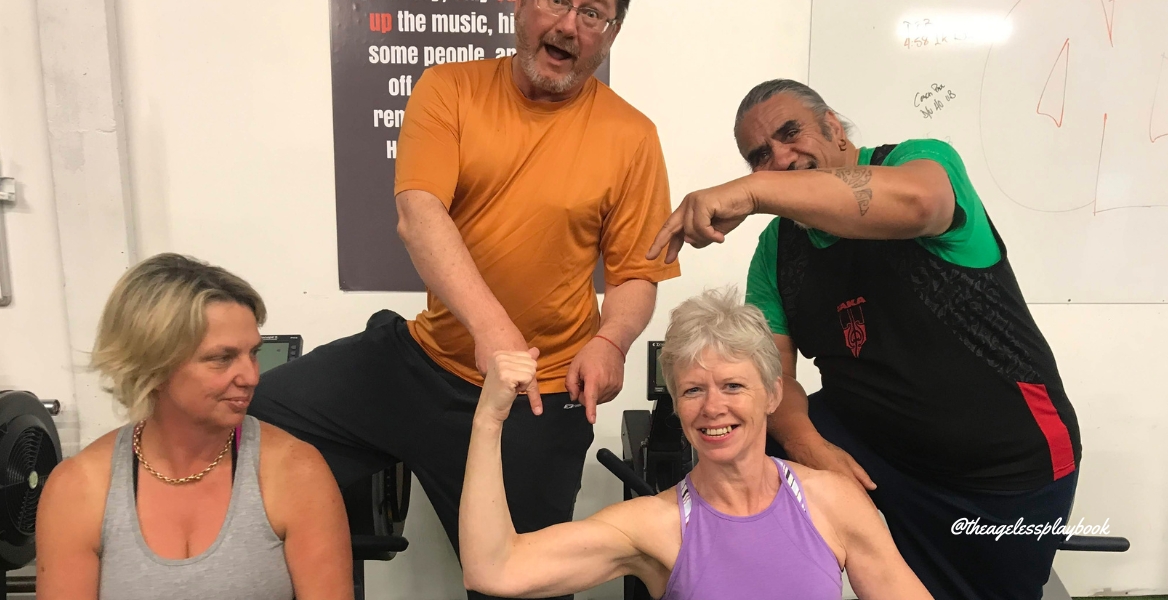
One of our members is eighty. She benches over 40kgs for reps of three.
That's not a party trick we found once and now trot out for marketing. It's what happens when someone in this age bracket gets a programme built properly around her rather than a watered-down one built for someone else.
The number surprises people who've quietly assumed strength has an expiry date around fifty. It doesn't. It just needs to be trained for, deliberately, the same way it does at any age.
The actual skill: serving a wide range in one room
This is where programme design stops being a spreadsheet problem and becomes a coaching problem.
The range within any 50+ group is wide. You can have a fit seventy-year-old who's trained consistently for a decade standing next to a fifty-eight-year-old who hasn't picked anything up heavier than a suitcase in thirty years, in the same session, on the same day.
A template, or an AI prompt, can't serve both of those people.
A coach can……..if the coach is actually paying attention to what's in front of them rather than running the same session regardless of who walks in.
Scale the load, not the ambition:
- The fit seventy-year-old still gets challenged appropriately for where they are.
- The detrained fifty-eight-year-old still gets challenged appropriately for where they are.
Neither one is doing a version of the session designed for the other.
That's not something you can programme your way out of on paper. It's a skill that lives in the coach standing in the room, which is exactly where this series is heading next.
Next week: why the coach you hire for this matters more than any certificate they're holding, and the one test I actually use to decide.
Cheers
Paul
If you're building the programme side of this out properly, the First Conversation Workbook covers how to gather the information in that first conversation that tells you exactly where someone actually sits on the training age spectrum, before you write a single session for them.